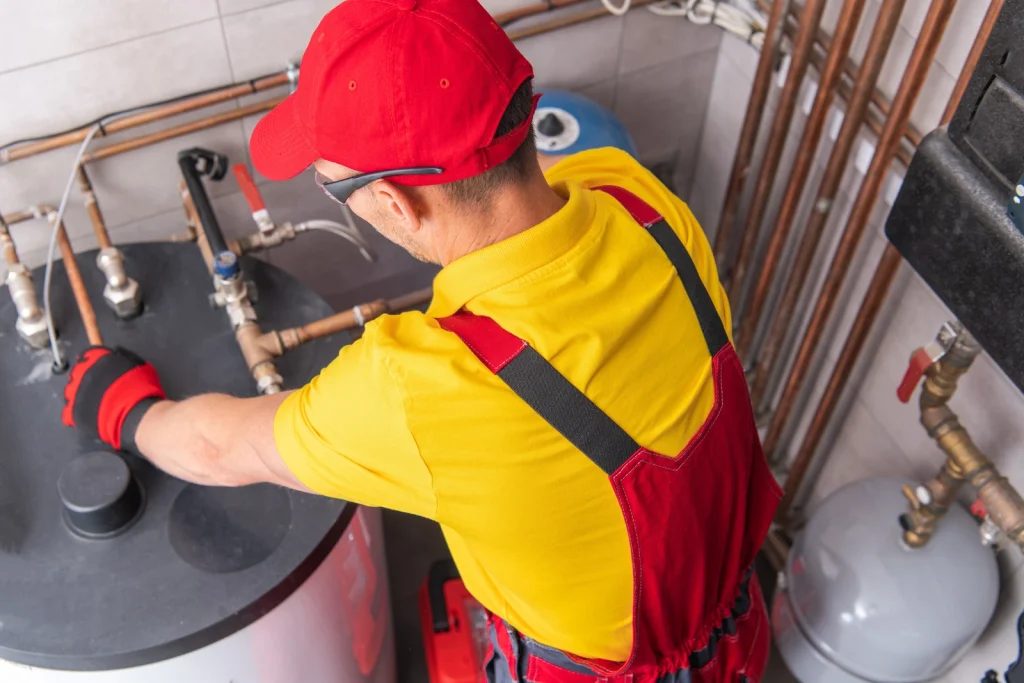
Water heaters in this part of Florida work harder than they do almost anywhere else. Our water comes out of a limestone aquifer loaded with dissolved calcium, and that mineral drops out of suspension inside the tank and bakes onto the heating surfaces. It is why a unit rated for a twelve-year life often gives up around eight here.
We repair what is worth repairing and replace what is not, and we will tell you which is which before you spend anything.
What our water heaters service covers in Dade City
- No hot water, or hot water that runs out too fast
- Leaking tanks, valves and fittings
- Thermostat, element and heating component replacement
- Anode rod replacement and tank flushing
- Tankless descaling, error codes and component repair
- Full replacement and code-compliant installation
What has gone wrong, based on the symptom
No hot water at all on an electric unit is most often a failed upper heating element or a tripped high-limit switch. On gas it is usually the pilot, thermocouple or gas control valve. Both are ordinary repairs on a tank that is otherwise sound.
Hot water that runs out much faster than it used to normally means sediment. Mineral scale accumulates on the tank floor and physically displaces water, so a 50-gallon tank might only be holding 35 gallons of usable hot water. A failed lower element produces the same complaint on electric units.
Rusty or metallic-smelling hot water usually means the anode rod is spent. That rod is a sacrificial component — it is designed to corrode so the steel tank does not. Once it is consumed, the tank lining is what corrodes next, and that is terminal.
Popping, rumbling or crackling during heating is sediment boiling underneath the scale layer. It is not immediately dangerous but it signals a tank working far harder than it should, and one heading for early failure.
Water pooling underneath the tank itself is the end. A leaking tank cannot be repaired at any price — the steel has corroded through. Shut off the water and power and plan on replacement.
Repair or replace: how we decide
Age is the first factor. Under eight years, a tank is usually worth repairing. Past twelve, we generally advise replacement even if the current fault is minor, because you are likely to be back here soon with a different one. Between those, it depends on the specific failure and the tank's condition.
The second factor is what has actually failed. Elements, thermostats, thermocouples and valves are all sensible repairs. A corroded-through tank is not repairable. If the fault is the tank, the decision has been made for you.
Third is what the repair costs against replacement. Once a repair approaches half the cost of a new, more efficient unit on an already-old tank, replacement is the better use of the money. We give you both numbers and let you choose.
Where a tank still has life in it, ordinary maintenance genuinely extends it. Flushing the sediment annually and replacing the anode rod every few years is cheap and adds years — particularly on our water.
Hard water is the reason these fail early here
Central Florida groundwater is hard. It moves through limestone and picks up dissolved calcium and magnesium on the way, and those minerals precipitate out when heated. Inside a tank they settle as sediment; inside a tankless heat exchanger they form scale on the walls.
The practical effect is an insulating layer between the heating element and the water. The unit runs longer to reach the same temperature, which raises your power bill and stresses the components. On electric tanks, elements buried in sediment overheat and burn out early.
Two things make a real difference. Flush the tank annually so sediment never gets deep enough to matter. And if you are running a tankless unit, descale it on schedule — for our water that means roughly every twelve months, not the "every few years" you will read in generic advice written for softer regions.
A whole-house softener addresses the cause rather than the symptom, and homeowners here who install one typically see water heaters, dishwashers and washing machines last noticeably longer.
Sizing and installing a replacement properly
Undersizing is the most common mistake. As a rough guide, a one or two person household is generally fine on 30–40 gallons, three or four people on 40–50, and five or more on 50–80 or a tankless unit. Large soaking tubs and multi-head showers push you higher.
A replacement is not simply a swap. Current code requires proper temperature and pressure relief discharge, correct drain pan and termination, appropriate seismic and structural strapping where applicable, and on gas units correct venting and combustion air. Pasco County requires a permit for a water heater replacement, and skipping it becomes a problem when you sell the house.
We handle the permit, install to code, and haul the old unit away. The job is finished when it passes inspection, not when the water gets hot.
How to book water heaters in Dade City, FL
Call or text 813-733-7188 and tell us what’s happening. We’ll give you a realistic arrival window, diagnose the problem properly, and put a written price in front of you before any work starts — honoured for 30 days. We serve Dade City and communities across Pasco County.